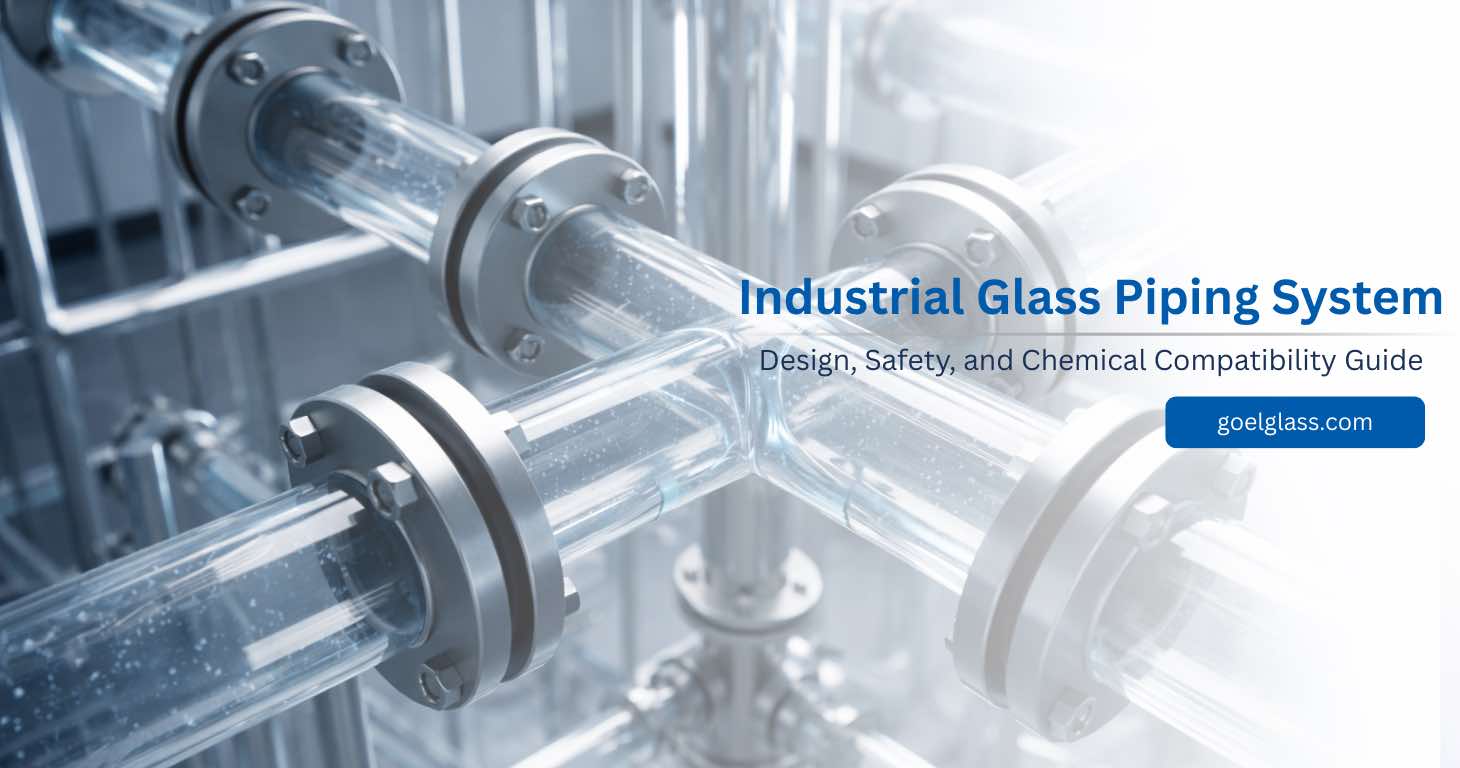
There is a specific kind of anxiety that comes with managing a pilot plant running aggressive chemistry in lined steel pipes. You know corrosion is happening you just can't see it until a flange weeps or the product yield drops due to contamination.
In the EPC world, industrial glass is the antidote. It transforms a black box process into a visual one. If you can't see the flow, you're guessing. This guide focuses on the engineering realities of specifying glass, drawing on the capabilities within the Goel Glass Inc industrial glass engineering portfolio.
Where an Industrial Glassware Supplier Recommends Glass Over Metal
We are not talking about laboratory beakers. We are discussing DN15 to DN600 structural equipment integrated into multi-story production units. An experienced industrial glassware supplier typically deploys these systems in three specific kill zones where metals fail:
- Pilot Plants : Where process visibility is critical for gathering scale-up data.
- Acid Recovery : Handling hot H₂SO₄, HCl, or HNO₃ where stainless steel dissolves in days.
- High-Purity API :Where metal ion leaching (Fe, Cr, Ni) would ruin a batch.
Borosilicate Glass Design Fundamentals
The primary material is borosilicate glass. It is incredibly hard and chemically inert, but structurally unforgiving of tensile stress.
- Pressure vs. Diameter : A 1-inch line handles pressure easily. A 24-inch column section is essentially a vacuum vessel.
- The Vacuum Advantage : Unlike PTFE-lined steel, glass doesn't collapse, permeate, or outgas under full vacuum.
The Role of a Pipeline Components Manufacturer in Safety
In a glass system, the pipe rarely fails the connection does. A quality pipeline components manufacturer uses shock-absorbing couplings (springs + inserts) to handle thermal expansion. If the flange is too rigid, the glass cracks.
Safety Engineering:
Safety isn't luck it's physics.
- Thermal Shock : The distinct ping of shattering glass comes from dumping cold solvent into a hot line. Most systems are rated for a sudden temperature difference of roughly 120°C.
- Mechanical Protection : In high-traffic aisles, simple transparent polycarbonate shields provide impact protection without sacrificing visibility.
- No Slurries :Never use glass for abrasive slurries at high velocity. It will erode, and you cannot weld a patch on it.
Chemical Compatibility and Material Selection
Glass is the universal donor it resists acids, halogens, and solvents. However, every material has an Achilles heel.
When NOT to use Glass:
- Hydrofluoric Acid (HF) : Dissolves the silica matrix instantly.
- Hot Concentrated Alkalis : Above 50°C, strong bases strip the glass wall.
For sensitive applications, review the industrial glassware product range to compare glass against exotic alloys.
Quick Reference: Glass vs. The Rest
| Feature | Borosilicate Glass | PTFE-Lined Steel | Stainless Steel (316L) |
|---|---|---|---|
| Visibility | 100% Transparent | Blind (Opaque) | Blind (Opaque) |
| Corrosion | Excellent (Universal) | Excellent | Moderate |
| Vacuum | High Stability | Risk of Collapse | High Stability |
Interoperability and QVF Glassware Standards
If you walk into a plant built in 1980 and one built today, the flange dimensions are likely identical thanks to the QVF glassware standard.
This standardization allows engineers to upgrade a legacy reactor overhead with modern glass process equipment systems without re-piping the whole skid. It allows for modular engineering swapping out a straight run for a heat exchanger with minimal downtime.
Evaluating a Custom Glassware Supplier and Glass Reactor Manufacturer
When specifying glass, you are buying fabrication precision. A 2mm deviation in steel is annoying in glass, it's a shattered pipe.
- Traceability : A custom glassware supplier must provide full traceability for GMP compliance.
- Logistics : Glass travels poorly. Sourcing industrial glassware in Canada or locally drastically reduces breakage risk compared to trans-oceanic shipping.
- The Ecosystem :Ideally, your glass reactor manufacturer also supplies the piping. This ensures thermal stress modeling accounts for the entire loop, from the reactor jacket to the condenser.
For complex setups like fractional distillation, the quality of these process glass components and assemblies defines the vacuum tightness of the whole unit.
Cost vs Lifecycle Value
Stop comparing purchase price. Compare lifecycle cost.
Glass doesn't corrode. It doesn't need painting. It doesn't require wall-thickness testing. Aside from gaskets, a glass pipe installed today can technically outlive the plant structure.
Contact Us and let's design a system that gives you full process visibility.