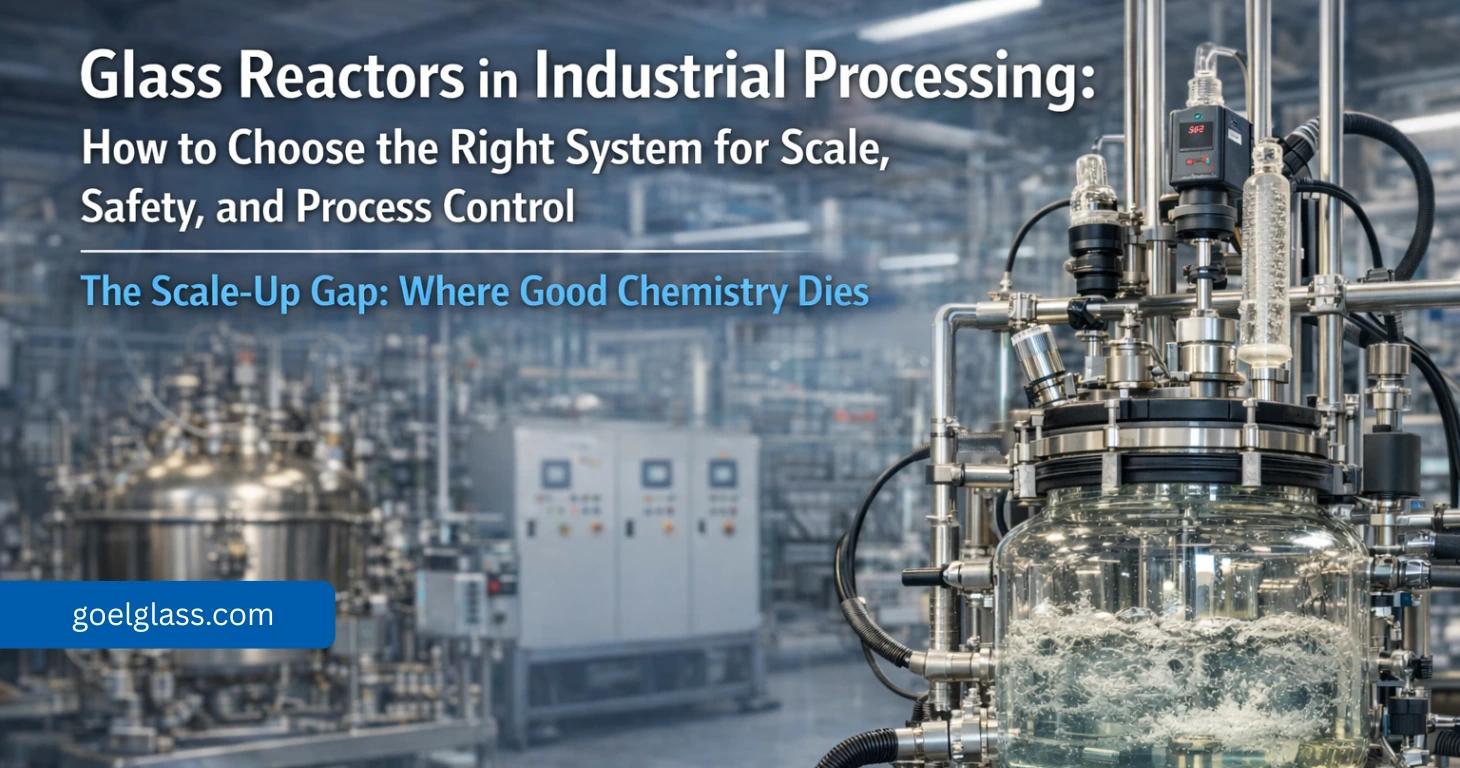
The Scale-Up Gap: Where Good Chemistry Dies
Scale-up is where good chemistry dies. A process works perfectly in the lab, but the pilot plant introduces a chaotic mix of fluid dynamics that glassware doesn't always forgive.
In a stainless steel reactor, you have durability, but you're flying blind. You rely entirely on sensors. If a phase separation stalls or an emulsion forms, you won't know until the batch is ruined.
This is why the Glass Reactor remains a staple. It offers the one thing metal cannot: Sight. But choosing the right system is a balancing act between visibility and industrial robustness. The solution often requires a dedicated multi purpose unit that bridges the gap between R&D and production. As engineers, particularly when sourcing a Glass Reactor in Canada & USA, we need to look past the glass itself and evaluate the engineering ecosystem.
Beyond the Vessel: Why Visibility Matters
Industrial glassware systems aren't just hardware , they are risk mitigation.
Metal reactors hide problems glass reactors reveal them.
- Color Changes : Catch the shift the second it happens.
- Phase Separation : Cut the interface exactly. No guessing.
- Fouling :See the crystallization on the walls before it kills your heat transfer.
We use Borosilicate glass because it is chemically essentially inert. Unlike metal, it won't leach ions into your product, and its low coefficient of thermal expansion (3.3 × 10⁻⁶ K⁻¹) handles the stress of rapid temperature shifts.
The Iron Triangle: Pressure, Temperature, Volume
Glass is tough, but unforgiving. Ignore the Iron Triangle of glass engineering and you will crack a vessel.
1. Pressure Limits
Glass excels under vacuum but requires strict pressure management. Standard industrial borosilicate systems operate safely under full vacuum down to 1 mbar absolute, with positive pressure capability governed by vessel size: up to +0.5 bar g for vessels ≤50L, and +0.4 bar g for 100L spherical vessels per BS EN 1595 / ISO 3585 standard ratings. The overall system pressure is always governed by the lowest-rated component. For high-pressure operations, metal reactors should be chosen; for pure, non-corrosive vacuum distillation and reaction, glass is unsurpassed.
2. Thermal Shock (ΔT)
Borosilicate Glass isn't magic. You must control the ΔT the temperature difference between the process fluid and the jacket coolant. Dump freezing glycol into a hot reactor, and you won't just ruin the batch you'll destroy the unit.
3. Volume vs. Surface Area
Volume scales cubically surface area scales squared. As you go bigger, heat transfer becomes your bottleneck. This is why the shell and tube heat exchanger design is critical. You need maximum surface area to handle the thermal load or you lose control of the reaction.
The Danger Zone : Just Make It Bigger
A pilot plant is not a large laboratory. Treat it like one, and people get hurt.
In the lab, you handle lab glassware manually. You pour, shake and stir. In a pilot plant, manual handling is a safety violation. You cannot simply buy a 50L beaker.
You need a system designed for industrial hydrodynamics. Vacuum charging replaces pouring. High-torque agitation replaces stirring. While reagent bottles are fine for static storage, active processing requires a system that mimics the geometry of a full-scale production plant.
System Anatomy: A Reactor is a System, Not a Pot
If you buy a bare vessel, you haven't bought a solution. You've bought a jar. The performance is dictated by the glass pipeline components that surround it.
To build a functional unit, you need to integrate specific engineered components:
- Glass Column with Splitter Section : A simple condenser isn't enough. A splitter section gives you manual or automated control over the reflux ratio.
- Sight Glass : Even in hybrid systems, a sight glass is non-negotiable. You need to verify flow.
- Glass Valves :Dead volume is the enemy. Standard valves trap liquid. We use specialized zero-dead-volume bottom outlet valves to ensure 100% of the batch drains.
Industrial Use-Case: Essential Oil Distillation
Consider Essential Oil Distillation. Purity is the only metric that matters.
Stainless steel is a financial liability here. Acidic oils react with metal. In high-value extracts like Rose or Oud, one metallic batch can burn $50,000 in revenue.
Industrial Glassware is the standard because producers need to see the oil break the exact moment oil separates from water.
- With Metal: You guess, sample, and risk oxidation.
- With Glass: You watch the separation and adjust the vacuum instantly.
The Canada Factor: The Math of Downtime
You are building a production line, not a museum exhibit. Things will break.
When you choose a Glass Reactor manufacturer in Canada & USA (or a supplier with deep Canadian inventory), you aren't being patriotic you're protecting your P&L.
- The Import Math: Ask yourself , Can your P&L survive a full quarter of zero revenue? Suddenly, that bargain import is the most expensive liability on your floor.
- The Local Advantage: Sourcing locally means spares, gaskets, and repairs are days away, not months.
It also ensures compliance. Canadian pressure vessel standards are strict. You need a partner who knows the code, not someone shipping a crate and wishing you luck.
Conclusion: Engineering for Uptime
The cost of a reactor is a rounding error compared to the cost of downtime.
Don't buy off a catalog page. Design for your specific constraints. Look at your valves, your thermal limits, and your reflux requirements.
If you're evaluating a Glass Reactor in Canada & USA, stop guessing. Contact Goel Glass Inc. Let’s review your pressure, temperature, and volume requirements and engineer a system that keeps your process visible, safe, and running.
Your frequently asked question
Yes, Goel Glass reactor systems and jacketed glass vessels are available in spherical configurations (5 L to 100 L standard, custom engineered up to 200 L) and cylindrical jacketed configurations (10 L to 50 L, along with benchtop models from 0.5 L to 5 L). We understand that process chemistries have unique requirements, so we offer extensive customization including specialized nozzle layouts, DN standard flanges, baffle inserts, and mobile support frames. Cylindrical vessels feature sealed Borosilicate 3.3 thermal jackets designed for circulating heat transfer media from -50°C to +200°C.
Key considerations include process batch volume (standard spherical vessels from 5L to 100L, custom to 200L; cylindrical jacketed vessels from 10L to 50L; benchtop systems from 0.5L to 5L), operating temperature and jacket differential limits (ΔT ≤ 50°C), pressure and full vacuum ratings (up to +0.5 bar g for ≤50L, +0.4 bar g for 100L), agitation viscosity and motor requirements, and zero-dead-volume flush bottom outlet valve selection.
- An exclusive Borosilicate Valve and tubing system designed to guarantee maximum purity and worker safety.
- Complete mobility is made possible by small, user-friendly equipment designs.
- Easy-to-use laboratory equipment on an industrial scale.
- A highly adaptable production system enables competitive lead times.
- Process glass vessels with jackets, available from 10L to 50L (and spherical reactor vessels from 5L to 100L standard, custom up to 200L).
- Temperature range for operation: -20°C to 200°C.
- Complete vacuum up to 1 bar (based on the diameter of the vessel).
- Glass lining steel, PFA/Steel, solid glass with PTFE propellers, or metallic Teflon coating agitators marked as "High Alloy"
- Use Kalrez O-ring shaft seals or Industrial Process Mechanical Seal configurations for Dry Running PTFE.
- Economical Duty Rated or Air Operated Electrical Motors with VFD Control.
- Choice: A lab hood or containment booth with a low sash or sliding doors may be easily accessed thanks to the support provided by the Hydraulic Lifting and lower system
- Process glass feed and receivers, coil heat exchanger, and jacketed
- Several other choices exist, such as automation, data acquisition, phase separation, solids addition, reflux control, and process control.