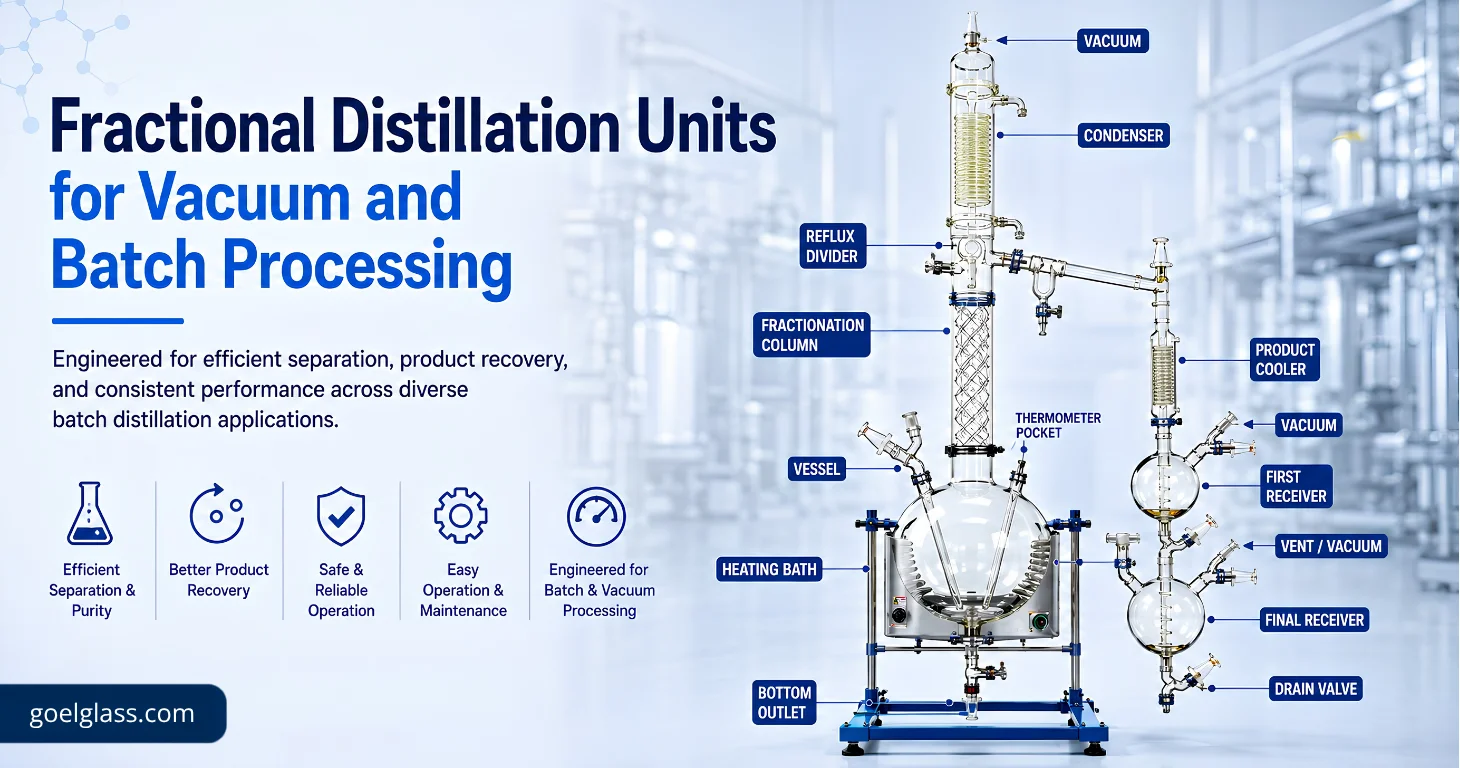
Distillation equipment rarely operates as a single vessel. Once a batch begins, vapours have to be condensed, liquid may need to be refluxed, and the final product has to be collected safely. Bringing these stages together inside one compact assembly helps keep batch operations organized from start to finish.
For facilities managing distinct production runs, a fractional distillation unit from Goel Glass Inc provides a practical setup. Facilities looking for reliable fractional distillation in Canada often prioritize flexible configurations and clearly defined capacities.
It brings the different stages of the process together in a single arrangement, allowing teams to manage batch operations under varying conditions.
Why Batch-Type Distillation Units Remain Practical
Operating a batch configuration means a facility handles isolated, contained runs from the initial charge through to final product recovery.
Because requirements can change from one campaign to another, production teams can manage individual batches without changing the overall assembly. This keeps the workflow adaptable to the immediate realities of the floor.
More Than a Boiling Vessel
It is easy to think of a distillation setup as just a boiling vessel. In practice, several industrial glassware components work together throughout the batch.
The heating bath, packed column, condenser, receivers, and drain arrangements are all part of the complete assembly.
At the base of the standard distillation unit, the reboiler consists of a vessel mounted in a heating bath. Positioned directly above this reboiler is a packed column.
Managing Vapours and Reflux
When the material reaches the top of the column, the vapours from the top are condensed. Following condensation, the condensed material can be refluxed as per requirement. Depending on the batch, a portion of the liquid may be returned to the packed column before the final product is collected.
Product Collection and System Turnarounds
Before final storage, the top product is sub-cooled. Once sub-cooled, this top product is collected in receivers. When the batch concludes, the bottom product is finally drained from the reboiler through a drain valve.
Operating Under Atmospheric Pressure and Full Vacuum
Process requirements vary from one facility to another. These units are suitable for operation under atmospheric pressure. The same unit is also suitable for operation under full vacuum, giving facilities additional flexibility when operating conditions change.
Choosing the Right Vessel Size
Because volume requirements vary significantly from one facility to another, fractional distillation units are available in standard vessel sizes of 20L, 50L, and 100L (with custom configurations up to 200L). The standard configurations include corresponding bath power, vapour line sizes, condenser areas, cooler areas, and receiver sizes for each vessel capacity.
Standard Capacity Options
| Model | Reactor Capacity | Bath (KW) | Vapour Line | Condenser HTA | Cooler HTA | Receiver Size |
|---|---|---|---|---|---|---|
| FDU20 | 20 L | 4.0 | 80 DN | 0.35 m² | 0.10 m² | 2L, 5L |
| FDU50 | 50 L | 6.0 | 100 DN | 0.50 m² | 0.20 m² | 5L, 10L |
| FDU100 | 100 L | 9.0 | 150 DN | 1.50 m² | 0.35 m² | 10L, 20L |
Planning a Suitable Distillation Layout
Whether working with a fractional distillation manufacturer in Canada or coordinating projects with a fractional distillation manufacturer in USA, reviewing vessel capacities, receiver sizes, and operating conditions early helps simplify system selection.
Because every application has different requirements, reviewing vessel sizes and operating conditions early can help simplify system selection.
If you would like to discuss your process requirements or explore available configurations, feel free to connect with us. Our team will be happy to help.