High-Performance Borosilicate 3.3 Coil Condensers
Goel Glass manufactures premium Borosilicate Glass 3.3 Coil Condensers engineered for efficient vapor condensation, aggressive reflux duties, and liquid sub-cooling across laboratory, pilot plant, and industrial process applications. Built by fusing multiple parallel helical glass coils within a heavy-walled borosilicate shell, these condensers provide exceptional thermal transfer while offering full 360-degree process visibility.
The smooth, non-porous glass surfaces completely eliminate chemical fouling, scaling, and catalytic contamination, ensuring pure distillate recovery and continuous performance with virtually zero pressure drop on the vapor side.
- Condensation 200 – 270 Kcal/m2, hr, °C appx.
- Cooling 100 – 150 Kcal/m2, hr, °C appx.
The average co-efficient of heat transfer in coil condenser is considered as :-
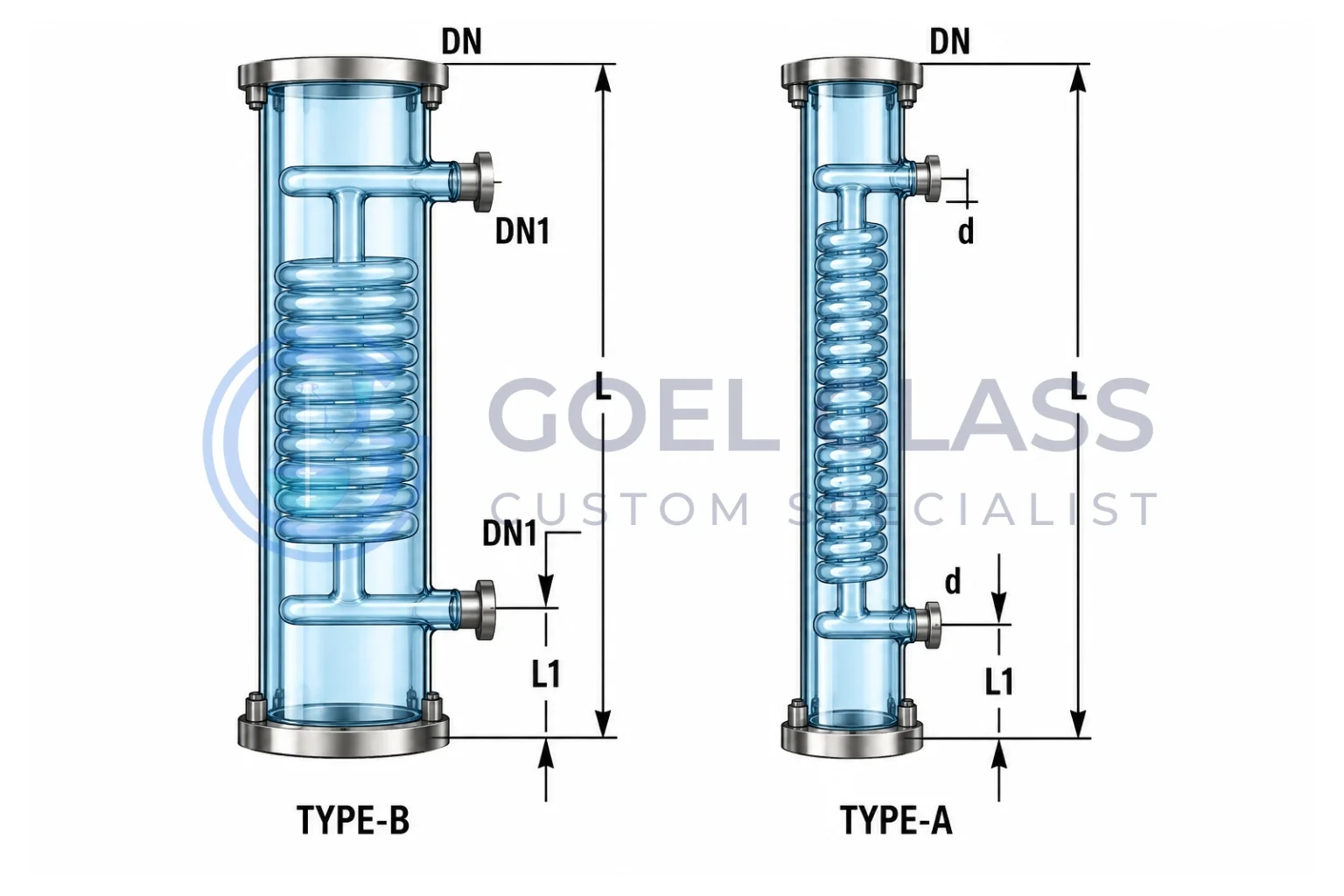
| Cat.Ref. | DN | d/DN1 | L | L1 | Type | Actual H.T.A. m2 |
Cross Area Cm2 |
Free Coolant Rate kg/hr. |
Max. Jacket Cap. Litre |
|---|---|---|---|---|---|---|---|---|---|
| HE3/3.5* | 80 | 16 | 600 | 75 | A | 0.35 | 5 | 1300 | 2 |
| HE4/5* | 100 | 19 | 600 | 75 | A | 0.50 | 30 | 2400 | 4 |
| HE4/6* | 100 | 19 | 750 | 100 | A | 0.60 | 30 | 2400 | 6 |
| HE6/10 | 150 | 25 | 600 | 100 | B | 1.00 | 52 | 2600 | 9 |
| HE6/15* | 150 | 25 | 850 | 100 | B | 1.50 | 52 | 2600 | 11 |
| HE9/25* | 225 | 25 | 800 | 110 | B | 2.50 | 125 | 3300 | 18 |
Precautions to be taken in use of condensers:
- Vapours should be passed through shell only.
- Maximum pressure of coolant should be 2.7 bars.
- Adequate flow of coolant should be used.
- Steam should not be used in coils.
- Coolant should not be heated to boiling point.
- Coolant control valve should be turned slowly.
- Coolant should be allowed to drain freely.
- Brine can be used in coils in a closed circuit.
- Water main should be connected with flexible hose.
- Ensure no freezing of water remaining in the coils.
- Condensers should be mounted vertically only.
- Condensers can be mounted in series to provide larger surface area.
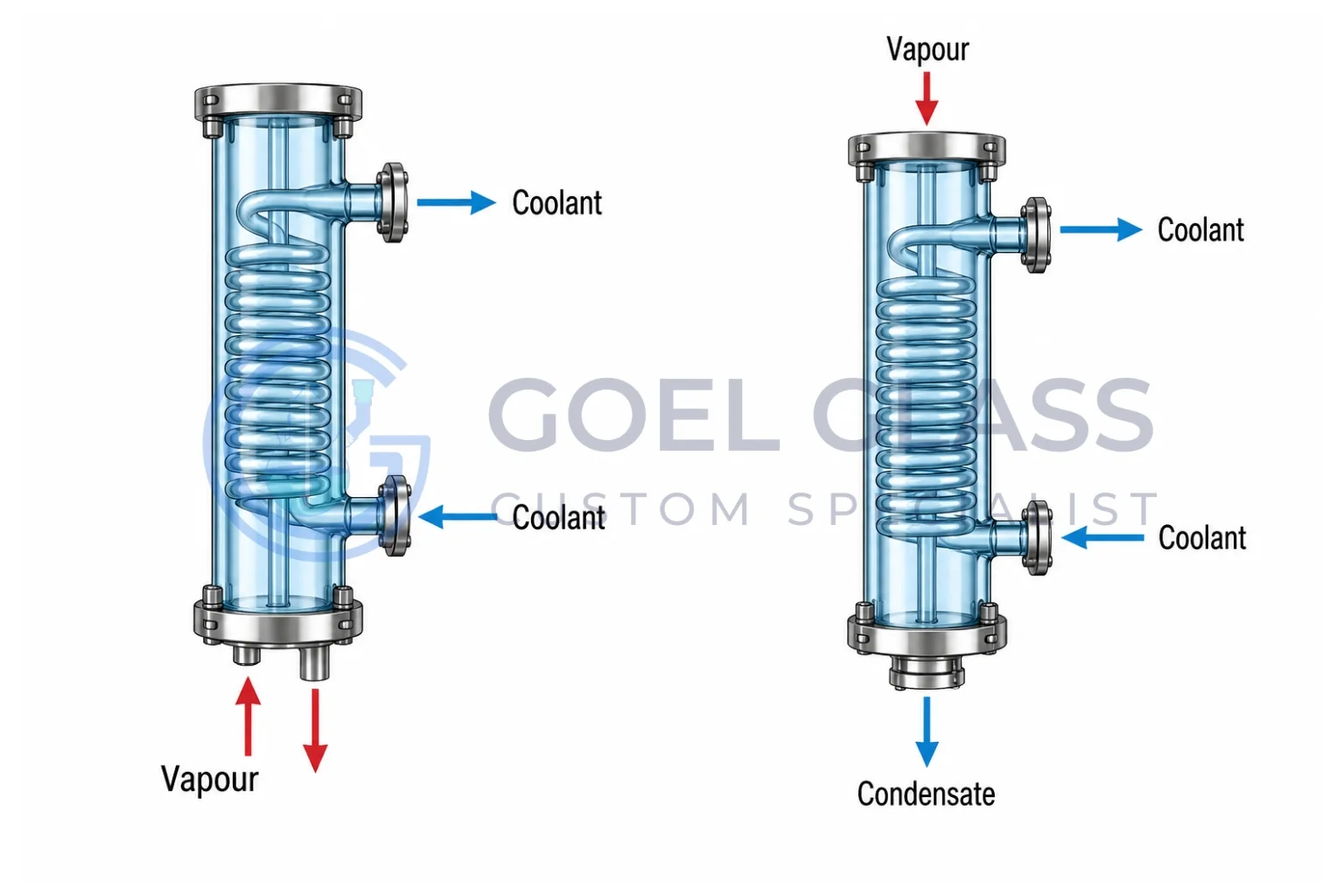
Methods of Use of Coil Condenser :
Vapours from bottom
This method is simple to install over a reactor. However this results in condensate returning substantially at its condensing temperature. In this method care must be taken that condensate is not excessive that it can lead to “logging” the coils and create back pressure in the system. Generally a reflux divider is used below the condenser to take out the distillate.
Vapors from top
This method produce a cool condensate using the entire coolinlg surface area. This method should be used where the condensate can lead to “logging” of coils.
Key Features
- Full Borosilicate Glass Construction: Immune to mineral acids, halogens, solvent mixtures, and chlorinated compounds.
- Leak-Proof Fused Construction: Coils are permanently fused into the jacket shell, eliminating internal elastomer gaskets.
- Vacuum Rated: Suitable for deep vacuum distillation down to full vacuum (-1 bar).
- Modular Flanged Ends: Standard flat or spherical beaded pipe connections ensure compatibility with Schott, QVF, and standard glass columns.
Applications
Widely used as overhead condensers in fractional distillation, reflux dividers, solvent recovery units, reaction vapor recovery, and corrosive gas condensation across Canada and the USA.