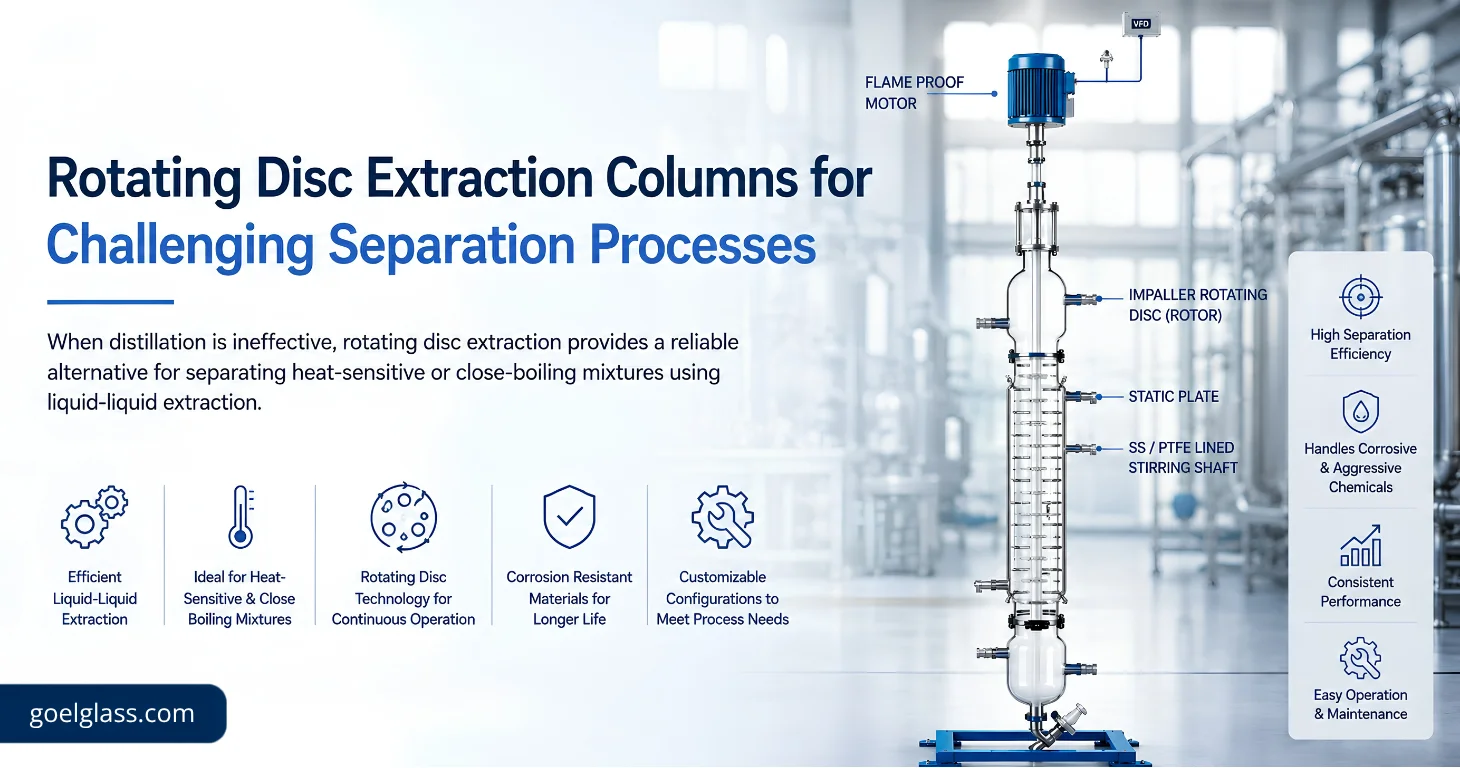
Distillation is usually the first separation method considered on the production floor. But it doesn't solve every processing challenge. In these situations, facilities often turn to liquid-liquid extraction. Running this continuously, however, requires specialized equipment designed around the process itself.
When Distillation Is No Longer Practical
When operators deal with mixtures containing closely boiling components, traditional thermal separation struggles to achieve a clean result. Other mixtures feature components that are highly sensitive to heat. Even when attempting to pull a vacuum on the system to lower the boiling point, these materials may still fail to withstand the required temperatures.
When distillation is no longer feasible or becomes ineffective, liquid-liquid extraction provides a highly practical alternative. Instead of relying on vapor pressure differences, this process utilizes distinct chemical properties like specific gravity and solubility to achieve separation.
By introducing a second liquid, which is a solvent, that is partially or wholly immiscible with the first , this approach selectively removes one or more components from a homogenous mixture or solution. To achieve this continuously on the floor, facilities rely on a Rotating Disc Extraction Column designed specifically for the process.
Constructing the Extraction Assembly
The system is built around a central rotating disc assembly. Depending on the process requirements, the column incorporates a varying number of stages within an overall height ranging from 1 m to 2 m.
Because extraction processes involve different chemical environments, the internal RDC blade can be manufactured from PTFE, SS 304, or SS 316 depending on customer requirements.
The outer column acts as the main structural housing. If temperature control is required, the outer column can be constructed as a jacketed pipe. Otherwise, it is supplied without a jacket, as per the customer specification. Supplying these setups as borosilicate glass columns in Canada gives operators clear visibility during operation.
Mechanical Drives and Floor-Level Infrastructure
The rotation of the internal assembly is provided by a standard geared-motor paired with an AC speed regulator. This gives operators direct control over rotational speeds. To maintain system integrity and prevent leaks around the moving parts, the agitator shaft is sealed securely by means of a mechanical seal.
If your facility requires custom configurations or fully engineered assemblies, reviewing our Engineering Packages helps clarify integration options for these drives, frames, and vessels.
A complete extraction system also includes the supporting components needed to manage material flow. Depending on the layout requirements, the unit can be supplied with two feed vessels, two receivers, and configurations with or without a dosing pump.
Evaluating Models and Specifications
No two extraction processes are identical. The diameter of the extraction column and the number of stages depend directly on the expected flow rates and the specific properties of the chemicals being used.
Facilities can select from a standard series of columns designated by size. The lineup includes:
| Model | DN (mm)Hight |
|---|---|
| RDC3 | 80 mm |
| RDC4 | 100 mm |
| RDC6 | 150 mm |
| RDC9 | 225 mm |
| RDC12 | 300 mm |
| RDC16 | 400 mm |
Across all these models, the overall column height remains a standard 2.0 m.
Sourcing Your Extraction Layout
Setting up a continuous extraction process requires careful hardware selection. If you are evaluating an extraction column manufacturer in Canada for your facility, Goel Glass Inc. distributes precision industrial equipment tailored to your specific process chemistry.
Because process requirements vary from one facility to another, material selection, flow rates, and overall configuration should be evaluated before specifying the final system. To discuss these requirements in greater detail, connect with our team .