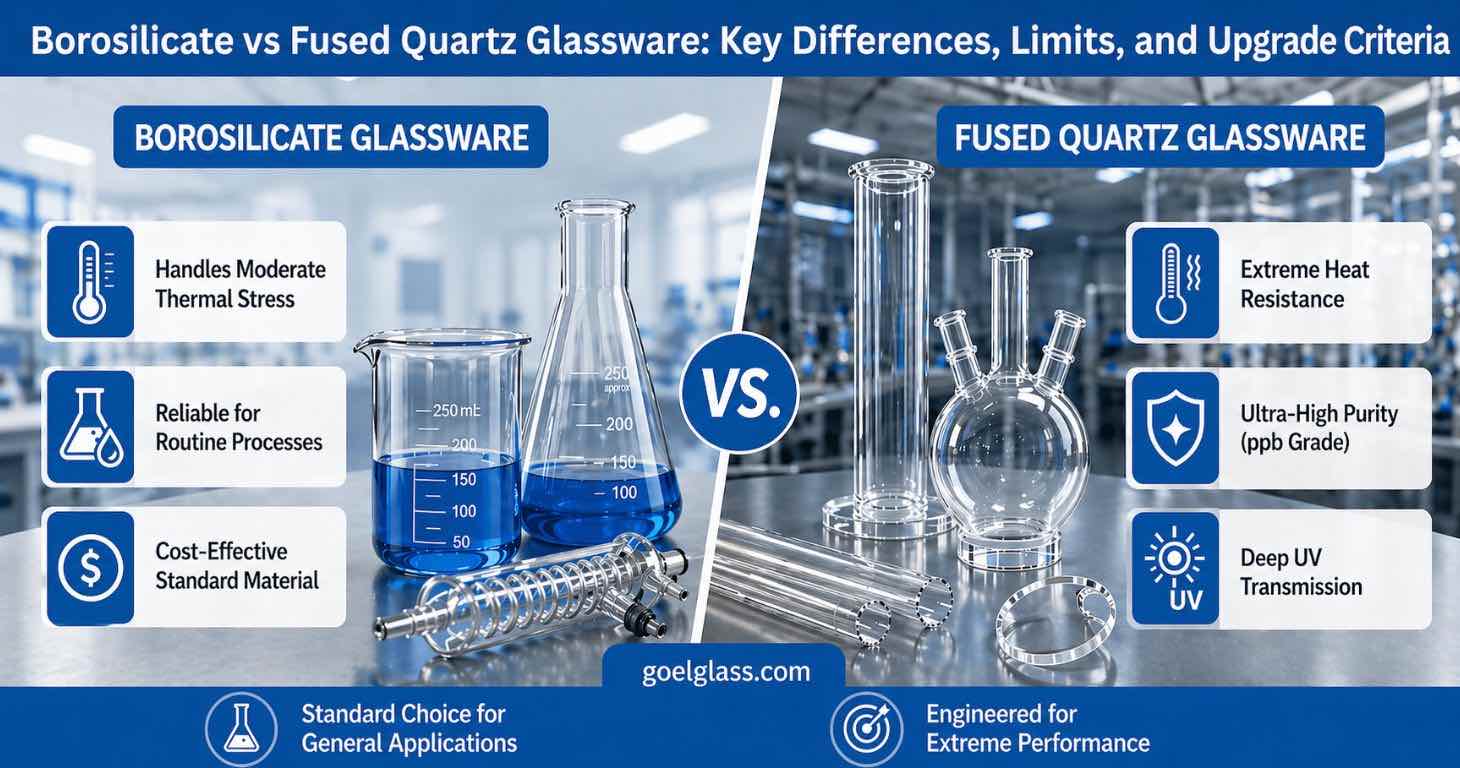
Borosilicate glass is the default material for standard industrial and laboratory processes. It is cost-effective and performs reliably under moderate chemical and thermal stress. However, every material has an absolute engineering limit.
When processes scale into extreme temperature zones or require ultra-trace analytical purity, standard borosilicate fails. Engineers must then specify a material engineered for those exact extremes. High-purity fused silica (quartz) is the direct, high-performance upgrade.
Here is the technical breakdown of exactly where borosilicate maxes out, and why fused quartz becomes the mandatory replacement.
The Thermal Breaking Point
Temperature limits are the primary driver for material upgrades in process engineering.
Borosilicate handles standard heating and boiling. But in environments like muffle furnaces, sintering, and calcination, temperatures easily push past its softening point.
The Quartz Upgrade: Fused quartz is specifically engineered to operate in extreme thermal environments, far surpassing borosilicate glass .
- Continuous Heat : Quartz safely handles continuous service up to 1100°C.
- Thermal Spikes : It tolerates short-term temperature spikes exceeding 1400°C.
- Thermal Shock : Borosilicate fractures if cooled too rapidly. Quartz features an extremely low coefficient of thermal expansion . You can subject it to rapid, severe temperature cycling without fracture.
Purity and Contamination Control
Standard lab glass leaches trace elements over time, especially when boiling aggressive acids. In routine lab work, this leaching is negligible. In semiconductor fabrication or ultra-trace analytical chemistry, it ruins entire batches.
The Quartz Upgrade : Quartz provides ultra-low contamination performance.
- Semiconductor Grade : Trace metal content in fused quartz is strictly maintained in the parts-per-billion (ppb) range.
- Compliance : This extreme chemical purity is a non-negotiable requirement for front-end semiconductor manufacturing, diffusion furnaces, and wafer processing systems .
- Analytical Defense : Quartz reaction vessels and distillation systems maintain chemical inertness against aggressive acids, alkalis, and solvents .
Optical Transmission Limits
Standard glass absorbs UV light. If an analytical process relies on ultraviolet spectroscopy or photochemical reactions, borosilicate creates an opaque barrier that destroys data accuracy.
The Quartz Upgrade : Optical-grade quartz is the standard for UV applications.
- The Transmission Range : Fused quartz delivers excellent transmission starting from deep UV (150 nm) straight through the visible and near-IR spectrums .
- Application : This uncompromised clarity enables advanced spectroscopic analysis, making quartz cuvettes and optical windows mandatory for analytical instrumentation
The Upgrade Checklist: When to Specify Quartz
If your current process triggers any of the following conditions, standard borosilicate is a liability. You need to upgrade to fused quartz.
- Operating Temperatures Exceed 500°C : Your process involves calcination, ash testing, or muffle furnace environments running up to 1100–1200°C .
- Rapid Temperature Cycling : The equipment undergoes severe, immediate heating and cooling phases .
- Parts-Per-Billion Purity is Required : You are manufacturing single-crystal silicon or preparing ultra-trace standard solutions for ICP/ICP-MS analysis.
- Deep UV Analysis : The application requires unhindered light transmission down to the 150 nm wavelength.
Sourcing the Upgrade
Replacing standard glass with high-purity quartz requires a manufacturer capable of meeting tight dimensional and purity standards. Goel Glass Inc specializes in exactly this transition .
Whether providing standard high-purity replacements (flasks, beakers, condensers) or engineering custom multi-component assemblies (reaction vessels, manifolds), Goel Glass supplies precision quartz components to the most demanding sectors worldwide. Contact our team to evaluate your process limits and specify the correct quartz upgrade